How it all started
A Victorian Inheritance
From a public meeting in 1890 to the ceremonial first ride on the seventh of July, 1892 — and the century and a third since.
Most passenger cliff railways were built at seaside resorts and the first appeared at Scarborough in 1875. The zenith of cliff railway construction was in the 1890s and 1900s. The pre-eminent of the cliff railway engineers during this period was George Croydon Marks.
1890
Where it began
A Public Meeting
In 1890 a public meeting was called to discuss a new means of communication between the High Town and Low Town of Bridgnorth, avoiding the need to scale the 200 or so steps. The meeting was reported in the local press, and the matter came to the attention of Mr. George Croydon Marks. Marks and Mr. George Newnes, M.P. subsequently laid a proposal before the town council for the erection of a Patent Cliff Railway, or inclined lift.
Plans were finally accepted for a route from the bottom of the Stoneway Steps to the end of the Castle Walk and consequently a company entitled The Bridgnorth Castle Hill Railway Company Ltd was registered in 1891.
1891
Construction begins
Cutting into the Cliff
The actual start of the construction work began on 2nd November 1891.
The cliff fought back.
Initial work was much hindered by the discovery of caves set into the cliff-face — one cave was so large it was necessary to support the roof to avoid slippage and subsidence. Another problem facing the construction work were the many houses built into the cliff face around the site — in some cases, the effect of excavating the cutting was to remove supporting walls from the poorly constructed dwellings.
At either end of the track station buildings were constructed.
1892
Rails, rock and rope
Engineering the Railway
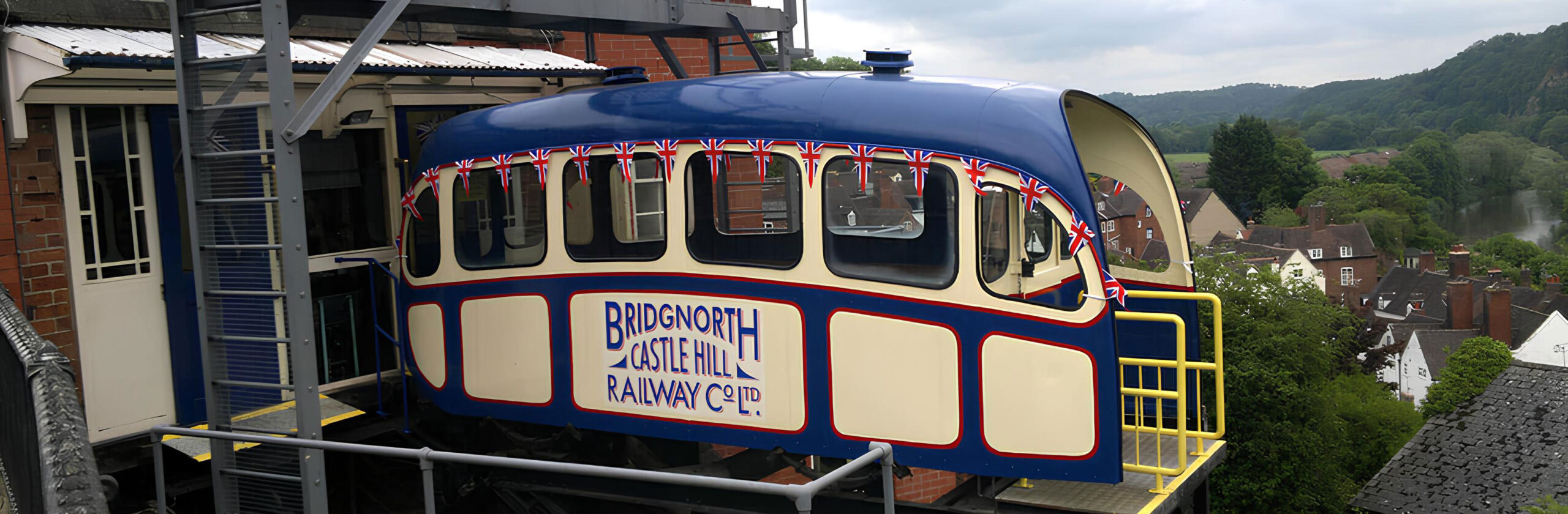
The original patented design of the railway was for a single track with two cars, with a crossing point mid-way between top and bottom, but this was abandoned in favour of a double track. When finished, the track measured 201 ft long, with a vertical rise of 111 ft. This gave the railway an incline of 1:1.81, or 33.52°, the steepest in inland Britain.
The rails were secured to sleepers which were themselves bolted into solid rock. At the upper end of the track, the hauling pulley was built on solid concrete foundations. Flat bottomed rails were used and the entire line was ballasted with concrete to avoid any slippage, with horizontal rollers set into the track at regular intervals to support the steel ropes.
Water as the motive power
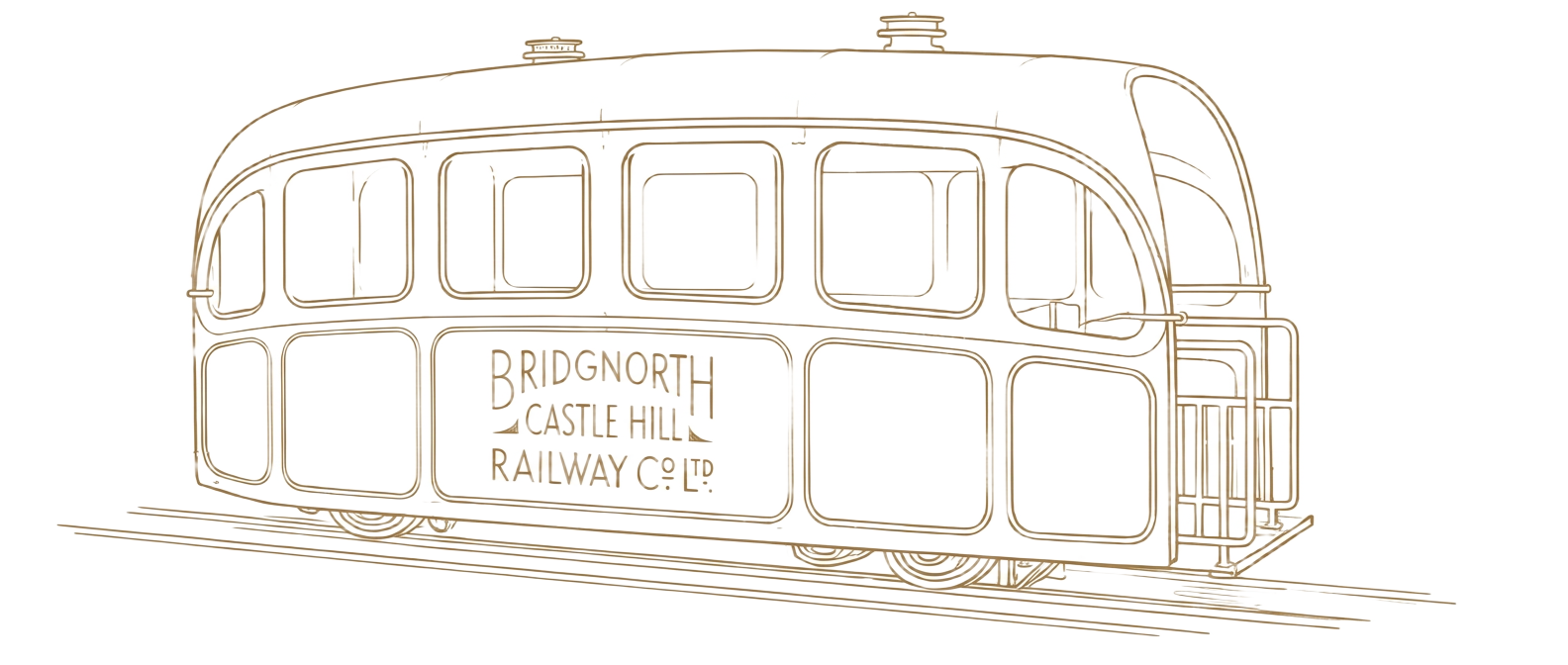
Each car was mounted on a triangular frame of steel girders which housed a 2,000 gallon water tank. The method of power was simple — the tank on the car at the top was filled with water from a 30,000 gallon tank mounted on the roof of the top station. As the top car filled, the tank on the bottom car was emptied, and the water pumped directly back up to the top station tank by a pair of pumps driven by independent Forward Gas Engines.
9 tons
Weight of the loaded top car
2,000 gal
Tank on each car
30,000 gal
Reservoir above the top station
- Fill
- Descend
- Empty
- Pump
- Return
Full, that water made the upper car weigh more than nine tons — easily enough to counterbalance the bottom car and its eighteen passengers, which simply rose as the other descended. A brakeman rode on the bottom platform of each car.
7 July 1892
Bridgnorth took the day off.
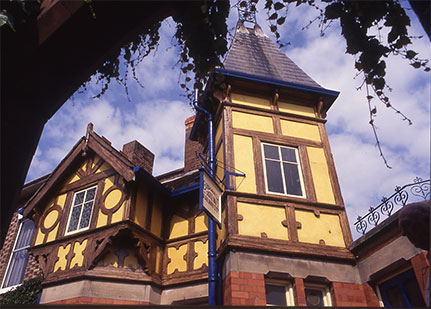
The ceremony was performed by the Mayor, John Anderson, a boot and shoe dealer born in Paisley, and in celebration the local townspeople enjoyed a public holiday.
Between July and September 1892 over 50,000 passengers used the railway. It then ran continuously for the next 41 years, until April 1933. In May 1934 it was re-opened by Frank Myatt, a brewer and hotelier who had been Mayor of Wolverhampton. His family continued to own the cliff railway for another sixty-two years.
50,000+
Passengers in the first three months
1944
A new kind of power
The Electric Conversion
By 1943 the gas engines were reaching the end of their working life, and this prompted a major rebuild of the railway. The hydraulic system of counterbalanced cars was replaced with an electrically operated mining type motor of 32 hp, winding two main ropes — one on to a drum as the other winds off — with a safety rope connecting the two cars via the original head wheel.
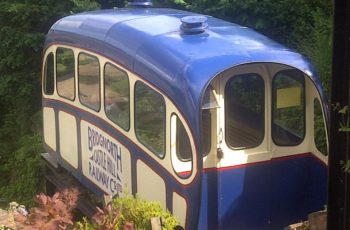
The conversion doubled the speed of the railway and brought with it modern safety equipment: interlocked loading doors, air braking on the winding drums and a dead man's pedal. The railway reopened in December 1944 and showed an immediate increase in traffic. In 1955 the passenger cars were replaced with a more modern type, with improved lighting.
2011 onwards
A family returns
Full Circle
In 1996 the entire share capital of the company was acquired by Jean and Allan Reynolds, who spent the next fifteen years investing vast sums of money in restoring and improving the cliff railway.
Bridgnorth Cliff Railway was purchased by the Tipping family in 2011. Two years later it was discovered that one of their maternal great-grandfathers was third cousin to the railway's founder, George Croydon Marks.
By a strange twist of fate, the cliff railway had come full circle — owned once again by cousins of the man who built it.
The Marks connection →
George had been born into engineering at the Woolwich Arsenal, where his father had worked. His parents had moved there from Somerset in their early twenties to escape rural poverty. His father had been the son of a poor farm labourer in the Blackdown Hills adjacent to Exmoor. They had family bonds with the north Devon Jones family.
The Tipping family's maternal great-grandfather came from Parracombe, north Devon. Marks was also a distant cousin of the branch of the Jones family which had founded another cliff railway at Lynton, four miles from Parracombe.
George Croydon Marks, who was knighted in 1911 and ennobled as Baron Marks of Woolwich in 1929, was Bridgnorth Cliff Railway's first managing director from 1891 until 1901. His brother, Edward, another engineer, became its second managing director from 1901 until 1924.
1892 → 2026
Water gave way to electricity, wooden cars to aluminium, gas engines to a winding motor, and one family's ownership to another's. The town above and the river below have changed beyond recognition.
"The cliff railway remains a constant in the town of Bridgnorth."
Its current owners and staff are very aware of that and its proud heritage.